Illustration: six separate modules of glass and metal join into a ring while pulses of light pass between them.

Agents that work on their own.You set the limits.

A self-hosted builder of independent AI agents. Budgets, approvals and memory come built in.

An illustration of the idea, not the product interface.An early product. Here is what is ready and what is not.

Small agents. One loop.

Illustration: six separate modules of glass and metal join into a ring while pulses of light pass between them.
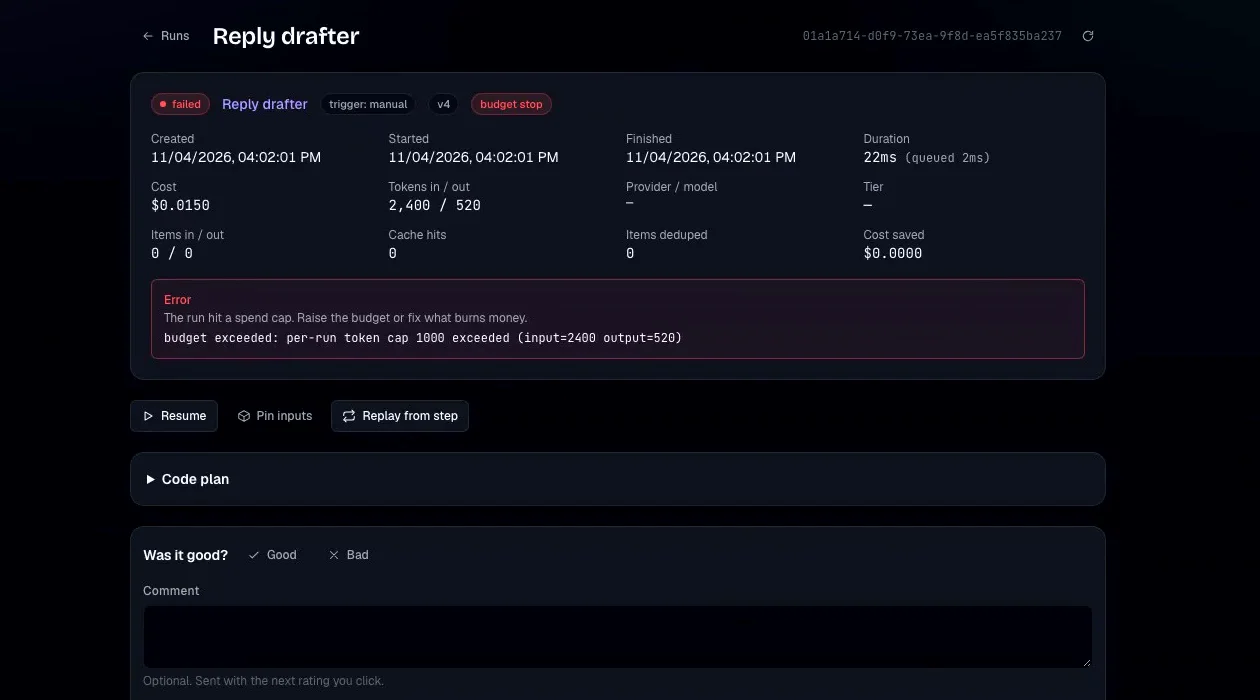
  1. One job each

    An agent is a single job in plain sections: trigger, inputs, task, output, actions and limits.

  2. Joined by records

    Agents never call each other. One publishes a record, and another wakes on it.

  3. Gates in between

    8 kinds of gates sit between agents: condition, schedule, filter, switch, delay, join, limit and wait.

Two ways to begin.

Build one agent with a mission of its own, or set up a whole team of them. The parts are the same.

One agent, or a few

Every agent has a mission.

Describe one job in plain sections, give it a trigger, limits and a say in what it may do. Let it work alone, or link a few: each leaves a record, and the next one wakes on it.

  • Start from one of 8 task templates
  • Chain agents with gates and records
  • A budget and an approval step on every agent
A company

A whole team, set up in one step.

A wizard lays out a team: 10 roles to start, and up to 32 in all. Each employee is a project with a main agent, its own budget and instructions, and you decide who may ask whom.

  • An editable roster, a mission and a shared chat provider
  • Projects, skills and agents created in one transaction
  • Lose the connection mid-way, reload, and you get the same company

You stay the owner: important actions wait for your approval. A company that runs itself is a goal, not a fact yet. The main agents answer from the model and do not run code; code-writing runs separately and you start it by hand.

What is ready and what is not

The product, up close.

Screens and recordings from a demo instance.

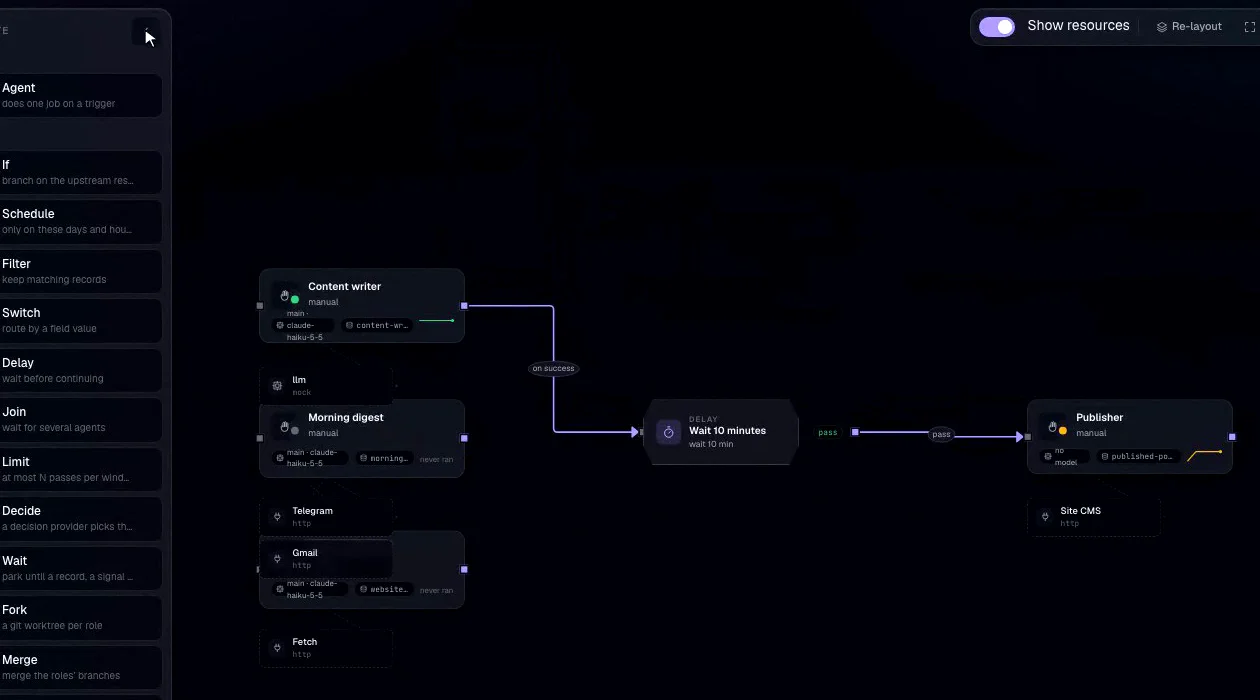
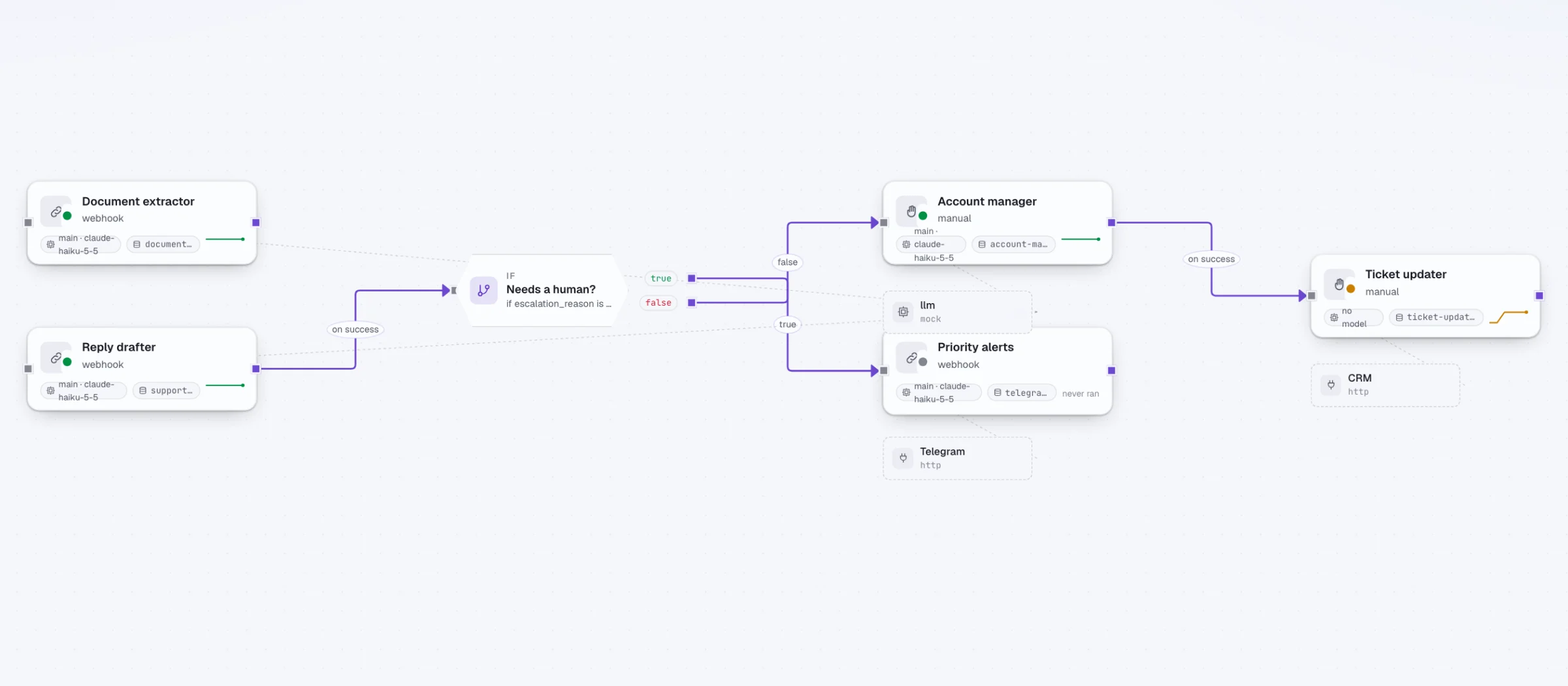
The canvas. Agents drawn in a project and linked by control edges, with a condition gate between them.

The canvas. Agents drawn in a project and linked by control edges, with a condition gate between them.

Real product screens. Demo data only.

The last word is yours.

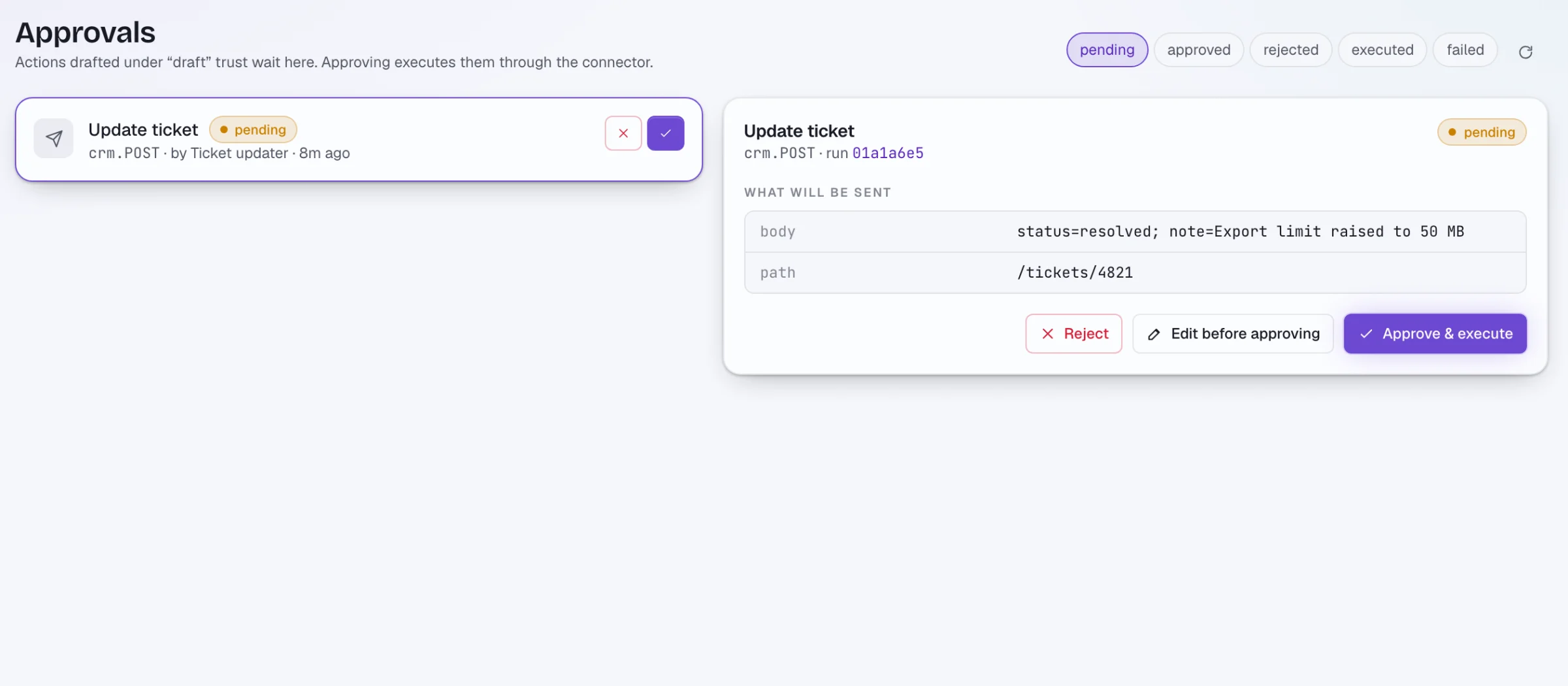
Anything important starts as a draft. You read it, change it if you need to, and approve it.

Illustration: a pulse of light held in front of a metal gate.

Three rungs, the lower one wins

Every action is read, draft or act. Set what the connector allows and what the agent asks for. The lower level decides.

Connector allows
Agent asks for
More on safety and control
Read Looks and learns. Runs without asking.
Draft Waits in the approval queue for a person. Connector allows Result
Act Runs now. Agent asks for

Every run has a ceiling.

Budgets sit on every run, on every agent per day and on every project per day. Set a cap and start a simulated run that wants a lot.

Illustration: a ring meter whose lit arc stops at a limit.
$1.00

This run wants $1.60

Spent $0.00 / $1.00

A simulation with example amounts. Template defaults are one dollar per run and five per day.

Token economy.

What keeps the bill small, and where you can see each part at work.

  1. 01

    Never twice

    How it saves

    Every input is hashed. An input the agent has already handled is skipped, so the model is not asked about it again.

    Where you see it

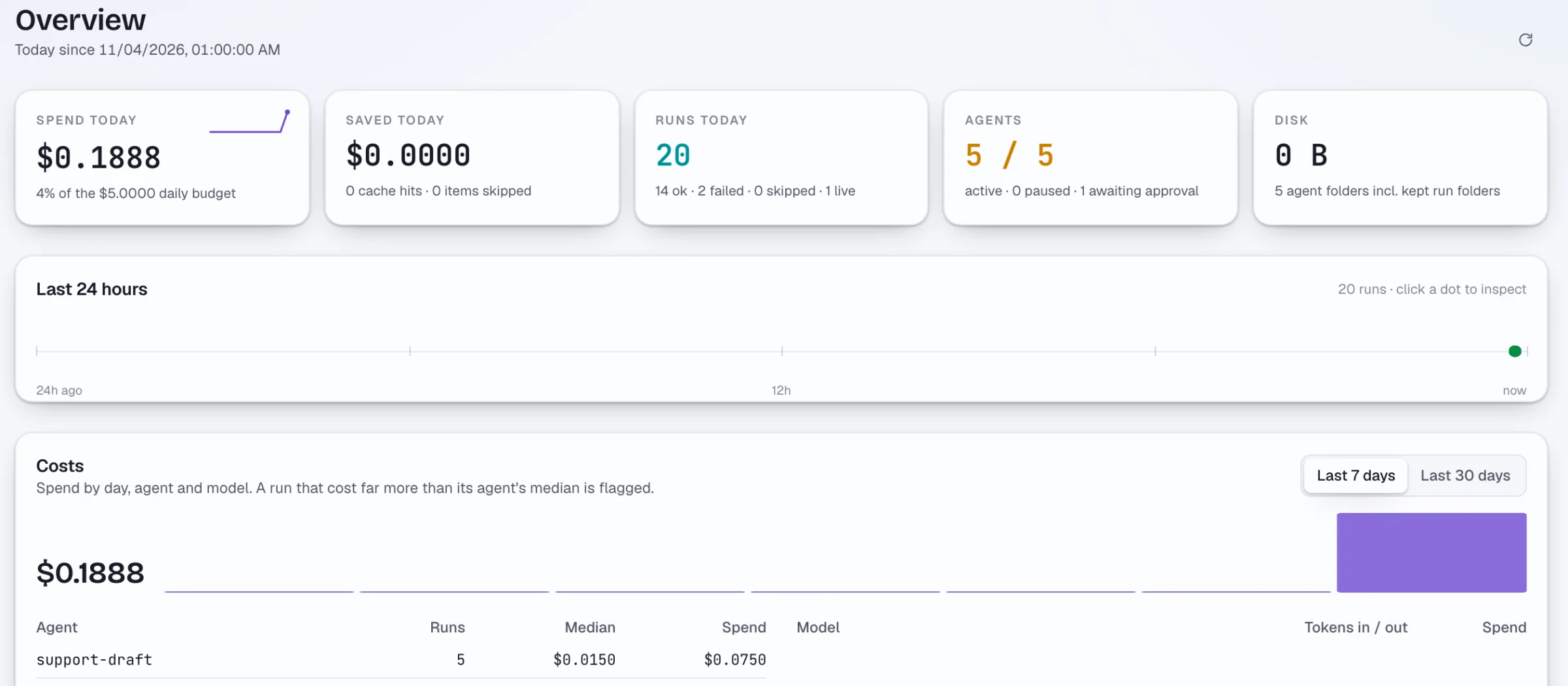
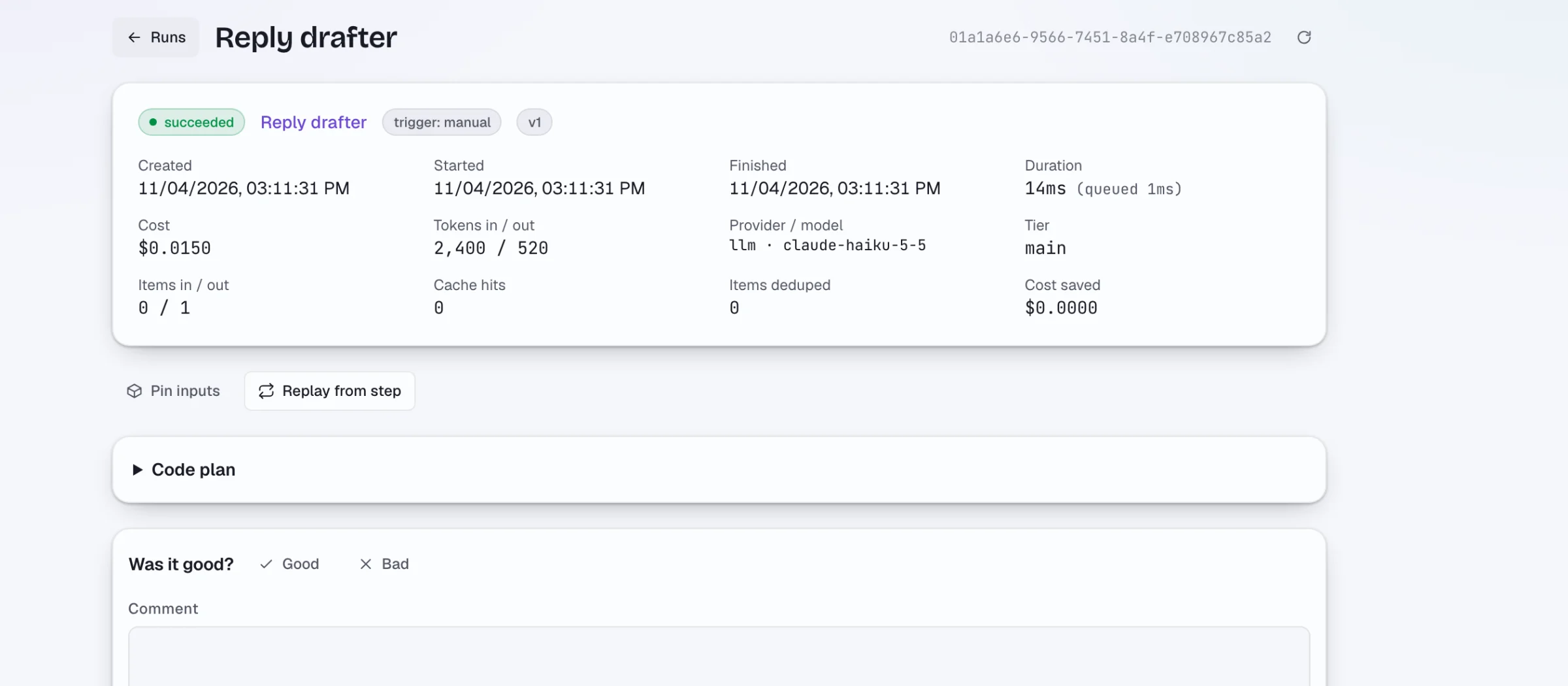
    The run page shows items deduped, and the overview shows items skipped.

  2. 02

    Remembered answers

    How it saves

    An identical request at temperature 0 gets the stored answer for 24 hours instead of a new call. Templates start with this switched off.

    Where you see it

    Cache hits on the run page, and the saved amount on the overview.

  3. 03

    The stable start, cached

    How it saves

    The unchanging beginning of a prompt is cached by the provider, so repeated runs pay less for the same prefix.

    Where you see it

    The overview shows what the savers kept.

  4. 04

    The cheapest model that fits

    How it saves

    In auto mode the router picks the cheapest enabled model that has the tools, vision, context and quality the task needs, and moves up only when a model fails.

    Where you see it

    The choice and the alternatives are written to the run log.

  5. 05

    A cascade that learns

    How it saves

    For each kind of task LOOPmKit remembers which models succeeded and starts the next run on one with a proven record: 14 days, at least 5 attempts and an 80 percent success rate by default.

    Where you see it

    You can ban or pin a model by hand.

  6. 06

    A ceiling on every level

    How it saves

    Budgets sit on every run, on every agent per day and on every project per day. A run over its cap is skipped with a budget error, and parallel calls reserve their share first.

    Where you see it

    The error on the run page, and spend against the daily budget on the overview.

  7. 07

    Every token counted

    How it saves

    Each run records tokens in and out, cost, provider and model.

    Where you see it

    The run page, and costs by agent and by model on the overview.

  8. 08

    Models on your own machine

    How it saves

    Ollama, LM Studio or vLLM answer on your hardware, with no API key.

    Where you see it

    A local provider is set up like any hosted one.

Cost is only as exact as the prices set for the provider.

Build from parts.

23 templates. Start from one task agent, or set up a team of role agents in one step.

Illustration: stacked modules of glass, ceramic and metal joined by thin lines of light.

One agent, one page

This is how a job is described: plain sections for trigger, inputs, task, output, actions and limits. An example, with simplified field names.

Examplemorning-brief.agent
agent: morning-brief
trigger:
  cron: "0 8 * * 1-5"
  timezone: Europe/Belgrade
inputs:
  - collection: news-notes
task:
  model_tier: cheap
  tools: [search, fetch]
  prompt: "Write a five-line digest."
output:
  schema: digest.json
actions:
  - send_message: draft
limits:
  per_run_usd: 1
  per_day_usd: 5
  timeout_s: 600
memory: off
  1. Draft waits

    The action is a draft, so it waits in the approval queue for a person.

  2. Output is checked

    The result is validated against a JSON Schema before it is stored.

  3. The cap

    A run over its budget is skipped with a budget error.

Under the hood.

Short answers first. Open a block for the details.

How an agent is built One job, described in plain sections.
  • Trigger, inputs, task, output schema, actions, limits and safety, permissions, memory and savings.
  • Agents are drawn on a canvas inside a project and linked there.
  • A draft can be written from a plain description.
  • Versions with a diff and a rollback, drafts, export and import.
  • Skills: reusable instructions with a version history.
What wakes an agent 5 kinds of triggers.
  • A schedule, with its own time zone for each agent.
  • A new record in a collection, with debouncing.
  • A webhook with JSON or files; the token is checked before the body is read.
  • A manual run with typed parameters, 7 types.
  • Another agent finishing. An agent that fails three runs in a row pauses itself.
Gates and flow 8 kinds of gates between agents.
  • Condition, schedule, filter, switch, delay, join, limit and wait for an event.
  • A failed run resumes from its checkpoint without repeating side effects.
  • Fork and replay from any step; tools with side effects run as a dry run.
  • A canary release for a new version, then promote or stop.
  • Swarm mode: a planner, parallel workers and a reviewer who merges the result.
Models and routing 25 provider presets, hosted and local.
  • A catalog of 232 providers supplies prices, context size and a quality class from 1 to 5.
  • Auto routing picks the cheapest model that fits, and the learned cascade starts on proven ones.
  • Shared providers can serve several projects.
  • A circuit breaker per provider is built; wiring it into fallbacks is in progress.
Connectors 61 presets in the gallery, and any MCP server or REST API by hand.
  • Mail, chat, code, data, documents, CRM, search and social, each as a preset.
  • Credentials sit in an encrypted vault. A connection is tested and its tools listed before it is saved.
  • The scope of a connector caps what an agent may do: read, draft or act.
  • An agent can be published as a chat widget, an inbound email address or an A2A endpoint.
Memory Each project keeps its own.
  • Recalled before a run and saved after it. If the memory service is down, the run goes on.
  • Private to the project, with a read-only shared layer.
  • Audience levels decide what an outward-facing agent may read: internal, client or public.
  • Consolidation and coverage views, and a project knowledge base.
Evals and quality Test an agent the way you test code.
  • 10 kinds of evaluators, up to 16 on one agent.
  • Golden datasets taken from real runs, replayed without side effects.
  • Two versions or two models compared by score.
  • An agent whose score falls below a threshold pauses itself.
Seeing what happened Every run leaves a trail.
  • Live logs and step-by-step run pages with tokens and cost.
  • Metrics for Prometheus and 11 alert rules.
  • Structured JSON logs with a request id.
  • OpenTelemetry spans and an error feed are built and not switched on yet.
Safety and control You keep the last word.
  • The trust ladder: read, draft or act. The lower level wins.
  • Drafts wait in an approval queue, and the approver can edit the arguments first.
  • An agent can stop and ask you a question; your answer resumes the run.
  • A policy per project and per agent, where deny wins.
  • Every finding of a security review has a regression test.
Self-hosting A Docker Compose stack on your machines.
  • The database, the memory service, the API, the web interface, search and speech-to-text.
  • Local models as an option.
  • A backup and restore script, and database migrations that are safe to repeat.
  • Product telemetry is off by default.

Runs on your machines

LOOPmKit is self-hosted: a Docker Compose stack, so agents, records and credentials stay where you run it.

Illustration: a sealed glass enclosure with a glowing core inside a metal frame.
  • Database
  • Memory service
  • API
  • Web interface
  • Search
  • Speech-to-text
  • Optional local models

Product telemetry is off by default. Model calls go to the provider you configure, or stay local if you use a local model.

What hurts, and what answers it.

Five kinds of buyer, in their own words, and the part of LOOPmKit that answers each pain.

Founders and small business

  • Every task lands on me.

    One secretary role takes the request and routes it to specialist employees, and you only approve. Live acceptance of this chain is still partial.

  • The AI bill is a surprise every month.

    Budgets on every run, agent and project per day. Savers skip repeated work, the router takes the cheapest model that fits, and the overview shows the spend.

  • Receipts and bookkeeping pile up.

    A ledger with sums done by SQL and receipts read from their fiscal QR code. The presets are for Serbia.

  • Enquiries wait too long.

    An account manager answers from the public layer of knowledge and keeps a card for each enquiry. Support answers from what may be said.

Operations

  • The automation ran twice, or quietly did nothing.

    Runs are durable. A failed run resumes from its checkpoint without repeating side effects, and an agent that fails three times in a row pauses itself.

  • I cannot tell what the agent actually did.

    A run page with every step, a journal of tool calls, eleven alert rules and a feed of errors grouped by signature. The error feed is built and not switched on yet.

  • Mail and digests eat the morning.

    Base templates for sorting mail, important mail to a chat and a morning brief. Live checks with real accounts are partial.

Marketing

  • Content takes a whole team.

    A chain from text to voice to a subtitled video, checked on a running stack up to a dry run.

  • I am afraid something goes out without my say.

    Nothing is published without approval. One approval covers one exact publication, duplicates are skipped, and quiet hours and limits apply. No real post has gone out through the product yet.

Engineering

  • I want specialist drafts and reviews, not a generic chat.

    Roles with stack skills for Go, PHP, Vue and databases. Code runs in isolated jobs on a git branch with no push. It was tried with a stand-in for the vendor tool, not a real subscription.

  • We do not want to depend on one model vendor.

    Twenty-five provider presets, local models among them, a cascade that learns, and a fallback.

Teams with sensitive data

  • The data has to stay with us.

    A Docker stack on your machines, PostgreSQL, secrets in an encrypted vault, and product telemetry off by default.

  • An outward-facing agent must not read internal notes.

    Memory is private to each project. Audience levels decide what an outward-facing agent may read, and leaks are scanned for. Guardrails for secrets, card numbers and IBANs are built and off by default.

And where it does not help yet

One operator, no separate organisations or role-based access. No certifications. A private repository. A company that runs itself is a goal.

What is ready and what is not

We run on it ourselves.

This is one operator's own working instance: the founder's, with test projects in it. These are not customers.

Snapshot of 4 November 2026, counted from the live database.

37
Projects
197
Agents
175 enabled
26,877
Records stored
62.7 million
Tokens
52,410
Duplicate items skipped before any model call
$13.50
Paid API spend

37,292 Scheduled runs, since 27 October 2026

  • 34,707 skipped, nothing new
  • 2,417 succeeded
  • 166 failed

2 more runs ended in another state.

Subscriptions are not counted in the spend. The failed runs are counted too.

How it compares.

Two things we did not find in the public docs of nine other products, and the rows where they lead.

  • Automatic routing to the cheapest model that fits.

    Built, with a cascade that learns from past attempts.

  • Three levels of trust for every action: read, draft, act.

    Built. Approving each dynamic call is not supported yet.

Not found in the public docs we read, 9 products, checked 4 November 2026.

Where the others lead

A hosted cloud, customers, certifications, a marketplace and a community, the number of connectors, telephony, and an open licence. We have none of these today, or only in part.

RowLOOPmKitn8nZapier AgentsDify
Agents trigger each other through records and events
Automatic routing to the cheapest suitable model
Hard budgets per run, agent and project that stop a run
Trust levels: read, draft, act
Isolated code execution
Hosted cloud offer
SOC 2 or other enterprise certification
Customers

Checked on 4 November 2026.

The full comparison, with sources

In the box

See every feature
61

connector presets

And any MCP server or REST API you add by hand. Credentials sit in an encrypted vault.

25

provider presets

Hosted or local. The router picks the cheapest model that fits the task.

23

templates

Eight task agents and a set of employee roles to start from.

10

kinds of evaluators

Test an agent the way you test code, with golden datasets and replay.

Straight answers

Where does my data live?

On your machines. LOOPmKit is a Docker Compose stack: the database, the memory service and your credentials stay where you run it, and credentials sit in an encrypted vault. Model calls go to the provider you configure, or stay local with a local model. Product telemetry is off by default.

More on safety and control
What if the model makes a mistake?

Output is checked against a JSON Schema, with a retry and a fallback model. Risky actions wait as drafts for a person, an agent that fails three runs in a row pauses itself, and a failed run resumes from its checkpoint. The model can still be wrong, which is why the approval step exists.

More on safety and control
Which models can I use?

25 provider presets: Anthropic, OpenAI, Gemini, DeepSeek, Mistral, Ollama, LM Studio and vLLM among them, so hosted and local models both work. The endpoints were probed; not every provider has been used in depth.

See every feature
How much control do I have?

You set what each connector allows (read, draft or act), budgets per run, per agent per day and per project per day, and policy rules where deny wins.

More on safety and control
What is not ready yet?

Plenty. This is an early product with a single operator and a private repository. Some finished features are not switched on yet, and the goal of a company run by agents is not reached. The status page lists all of it.

What is ready and what is not

For investors

What exists today, counted from the code and its notes. Nothing on this page is a forecast.

Built so far

Features in the list
102
Feature groups
14
Implemented and tested
83
Checked on a running stack
7
Connector presets
61
Provider presets
25
Templates
23
Kinds of evaluators
10

Who it is for

  • Founders and small businessEvery task lands on me.
  • OperationsThe automation ran twice, or quietly did nothing.
  • MarketingContent takes a whole team.
  • EngineeringI want specialist drafts and reviews, not a generic chat.
  • Teams with sensitive dataThe data has to stay with us.

Why now

Teams are starting to give AI agents real work. The first problems they hit are cost that runs away, mistakes that reach a client and dependence on one model vendor. LOOPmKit is built around those three.

Founder

Vitalii Cherepanov builds and runs LOOPmKit. vbcherepanov.com

Stage: early. One operator, a private repository, no public release and no set terms. This page makes no claims about market size, users or revenue.

Talk to the founder for 20 minutes

Download the deck (PDF)

Early access starts with a call

The product is at an early stage with a single operator. The repository is private and the terms are not set. If this fits a problem you have, book a short call.

A 20-minute call with the author. The repository is private, so a conversation is the way in.